Consider this . . .

Point to ponder. Take a moment to consider it. Then create your own point to think about, and share back.

Tuesday, September 26, 2006

Picky Eaters

The Picky Eater Files

For Some -- You Know Who You Are -- Meals Are a Minefield of Phobic Flavors and Terrible Textures

Washington Post Staff Writer
Tuesday, September 26, 2006; Page HE01

At age 51, Billy Shore -- founder and chief executive of the anti-hunger charity Share Our Strength in Washington -- has some food issues himself.

Shore pretty much hates "the taste and texture" of all vegetables, except spinach and corn on the cob. And those two are fairly recent concessions in an otherwise vegetable-free life.


Denise Davis, 44, an elementary school teacher from Springfield, can't abide fish because "the smell is off," and has no use for most veggies. "I pick the peas out of pot pies," she says. "There used to be four peas per pie, and now I notice there are five."

Self-described "meat and potatoes guy" Lincoln Tyson, 32, who owns a consulting firm in Laurel, was at a glam dinner hosted by Tiffany & Co. last year. The social circumstances compelled him to choke down at least some of the very first salad he'd eaten in his life. Never again.

Shore, Davis and Tyson are among legions of adult picky eaters, otherwise intelligent men and women who banish from their diets specific tastes or textures or sometimes entire food groups. They are grown-ups who somehow haven't outgrown the finicky food preferences most of us leave behind once we're out of the highchair. Or college, at least.

Pass them on the street and you'd never know the quirks they harbor. But invite them over for a meal or join them at a restaurant and the truth emerges. Some find pasta and oysters too slimy. Others can't bear chewy meats, gritty berries, rubbery cheese or mushy tomatoes.

There are those who shun "foreign" or spicy foods as a category, or all produce with seeds (especially okra, which when overcooked marries seeds with slime, making it a true picky-eater nightmare). There are the dairy-averse (ice cream is often a notable exception) and condiment-phobes, who wouldn't consider defiling their food with mustard, ketchup, mayonnaise or relish.

Some finicky eaters will not mix foods on the same plate, or they insist on finishing one item entirely before starting the next. Others refuse to eat anything at all with their hands, whether a sandwich, peanuts or pizza.

Fairfax insulation contractor Steve Fye, 58, will not eat foods that have touched each other on his plate. "I don't think of it as a disorder," he says, "just kind of curious."

These are not people, you understand, with medical conditions or religion-based food restrictions. Nor are they dieters, cuisine snobs or diners who simply prefer steak well-done rather than rare.

They are otherwise well-adjusted adults with unyielding, often secretive, eating practices.

"A normal person might enjoy hundreds, if not thousands" of combinations among all the fruits, vegetables, meat, fish, fowl, grains, nuts, juices, herbs, soups, sweets, sauces, spices, desserts and flavorings in today's markets, says Marcia Pelchat, a food psychologist.

By contrast, adult picky eaters in extreme cases limit themselves to as few as 20 or 30 tolerable edibles, says Pelchat, who works at the Monell Chemical Senses Center, a research institute in Philadelphia specializing in taste, smell and nutrition.

"For cooked vegetables, it's the texture," Pelchat says. "Those in the cabbage family have a lot of sulfur, so that when cooked they stink. For a lot of picky eaters it's the texture of things like raspberries and strawberries. Even I was thrilled to find out you could get strained blackberry jam."

That's Sick


Although it is not known how many American adults are picky eaters, a growing number are seeking treatment, says Bradley C. Riemann, clinical director of obsessive-compulsive disorders at Milwaukee's Rogers Memorial Hospital, which treats numerous patients with eating issues.

"All of a sudden, in the past six months to a year, it is bursting out more than I have seen in my entire 18-year career, partly because there is so much public awareness of obsessive-compulsive disorder," or OCD, Riemann says. "Typically, this is not OCD-related but there is a fear reaction [to specific foods], disgust, and it is affecting their lives."

But picky eaters can become seriously ill or depressed, says Riemann. "The line between food preferences and disordered eating is whether it hurts their quality of life."

The chronically finicky often feel comfortable eating only in private, because at parties and restaurants the sight, smell or texture of foods they dislike can make them physically ill.

"The important defining question is, do they worry when they have to go out -- to a business lunch or dinner, or to someone's home for the weekend, where they cannot control the food. They're not just worried about finding something they'd like to eat, but there is some embarrassment admitting this to new people," Pelchat says.

Picky adults exhibit "extreme reluctance to try new foods. A cocktail party is a nightmare because you have all these enclosed packets [of finger foods] and you don't know what's inside," she says.

Picky Loves Company


A lifetime of mealtime agony drove Virginia Beach businessman Bob Krause, 59, to start a Web site ( http://www.pickyeatingadults.com/ ) , which in four years has drawn about 300 fellow sufferers to share their tales of woe in a cyber-support group. One of them is made miserable by frequent potluck lunches at work. Another eats only the blandest of foods, such as cereal.

"They think they are the only ones" until they find the Web site, says Krause during a phone interview -- conducted from home, so he would not be overheard by his employees.

A self-described "hyper-picky eater" who consumes little more than raw carrots and celery, french fries, potato chips, pretzels, peanut butter crackers, cereal, beer and milk, Krause will not dine at friends' homes; he will go to a restaurant only with his wife.

"She will have a three-course meal and I might have a beer and french fries. In fancy restaurants, the fries might come with spices, batter or vinegar, and there I am with french fries I can't eat and two beers," says Krause. In his universe, Thanksgiving is "Black Thursday."

Fye, the Fairfax insulation contractor, explains his rule against eating two foods that have touched each other as a kind of preference. He eats each food in sequence.

"Part of it is relishing each different taste and part of it is the texture. If we have a salad, I can't eat it with the dinner. I eat it first."

His wife serves his food on a plate large enough to prevent the dreaded overlap. "I spin it around and whatever is in front of me is what I eat first. I realize that it all goes down the same hole and gets mixed up. But I don't like to do it that way. I can't help myself."

Fye is a gracious guest when he visits friends who serve stew or casserole: "I'll take it apart with a fork and sample each item." In restaurants, he bypasses foods that have come in contact with each other. "I'll build a little wall with mashed potatoes and not eat the portions that touched." Anti-hunger crusader Shore occasionally forces down spinach or corn when dining with some of the nation's top chefs who support his charity. But at a friend's wedding dinner last week, he ignored the gazpacho, ate only nuts and cheese from the salad, enjoyed the steak but nixed the German chocolate cake because "I've never been able to stand coconut."

Extreme eating habits almost killed the romance for JoAnn Polickoski, 34, who lives in a suburb of Columbia, S.C. In the early 1990s, her Marine boyfriend flew her to Spain for a vacation that was to include a marriage proposal. But James Polickoski, 34, did not fully comprehend his sweetie's ironclad culinary credo: "If it looks like what it is -- if it has a head, bones or scales -- forget it."

When confronted by the day's catch in a quaint seaside restaurant, "she completely melted down," he recalls. The paella he ordered contained "oversize prawns and crawfish with heads on. She wouldn't eat anything; she wanted to go to McDonald's, to eat commissary food. We had a horrible time."

He waited a year to give her a ring, and did so only after she promised him "to try every food at least once. She can't just look at it and freak out. I told her I can't eat this way and if we're going to have kids" -- their fourth was born in May -- "they are not going to grow up to be finicky. It was hard for her, but she agreed." ·

Comments: groera@washpost.com.


Check Out My Other Blogs (click on blog name to go there) = / 1.3rd Eye Blog / 2. Favorites Blog/ 3. Vita Excolatur (Living Well ...) Blog/ 4. Humor Me Blog/ 5. News and Current Events Blog/ 6. Consider This ... Blog/ 7. Consumer Warnings Blog/ 8. New Orleans Pentimento Blog/ 9. We Constant Gardeners Blog/ 10. Chaillot Family Blog/

Sunday, September 24, 2006

Homework No More

family: Snapshots of life at home.

Forget HomeworkIt's a waste of time for elementary-school students.


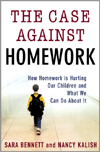
The Case Against Homework by Sara Bennett and Nancy KalishOver the last decade, Japanese schools have been scrapping homework while American elementary schools have been assigning more of it. What gives—aren't they supposed to be the model achievers while we're the slackers? No doubt our eagerness to shed the slacker mantle has helped feed the American homework maw. But it may be the Japanese, once again, who know what they're doing.

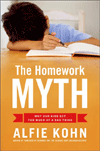
Such is my conclusion after reading three new books on the subject: The Case Against Homework by Sara Bennett and Nancy Kalish; The Homework Myth by Alfie Kohn; and the third edition of The Battle Over Homework by Duke psychology professor Harris Cooper. If you already despise homework, Bennett and Kalish provide advice on how to plead with teachers and schools for mercy. If you're agnostic, as I was, Kohn is the meatier read. Kohn is the author of several rebellious books about education, and he exposes the lack of evidence for many of the standard arguments in favor of homework: that it boosts achievement, that it inculcates good study habits, that it teaches kids to take the initiative, that it's better than video games or whatever else kids do in their free time.

Cooper is one of Kohn's main foils and a leading scholar on the subject, so I picked up his book expecting to find a convincing counterargument defending homework. I didn't. Cooper's research shows that, much of the time, take-home assignments in elementary school are an act of faith. No one really knows whether all those math sheets and spelling drills add up to anything. If there's little or no evidence that younger students benefit from homework, why assign it at all? Or, to adopt Kohn's less extreme position in The Homework Myth, why make homework the rule rather than the rare and thought-through exception?


Click Here!

In The Battle Over Homework, Cooper has crunched the numbers on dozens of studies of homework for students of all ages. Looking across all the studies is supposed to offer a fairly accurate picture even though the science behind some of them is sketchy. For elementary-school students, Cooper found that "the average correlation between time spent on homework and achievement … hovered around zero." In Kohn's book, he highlights a 1998 study that Cooper and his colleagues did with second- through 12th-graders. For younger students, the amount of homework completed had no effect on test scores and bore a negative relationship to grades. (The results weren't quite so grim for older students. Their grades rose in relation to the amount of homework they completed, though their test scores did not.) Kohn looks at these findings and concludes that most homework is at best a waste of time and at worst a source of tedious vexation.

Cooper, despite his findings, continues to back the "10-minute rule"—10 minutes of homework in kindergarten and first grade, with 10 more minutes for each additional grade level. For support, he zeroes in on six studies conducted between 1987 and 2003. These included third- through fifth-graders, and they compared kids who did homework with kids who didn't. (In a rare moment of good science in this field, the kids were assigned randomly to one group or the other in four of the studies.) The homework kids performed better, but only on a "unit test"—a test of the material they'd been sent home to study. Which means that Cooper's best evidence doesn't refute one of Kohn's central claims—that the measurable benefits of homework diminish the longer students are tracked for. Take a snapshot of a math quiz on fractions after kids drill fractions at night and homework looks good. Take a longer view and the shine comes off.

Cooper's support for the 10-minute rule actually makes him a voice of homework moderation in light of evil-homework tales of kindergartners slogging through 130-word lists. But as Kohn writes, "We sometimes forget that not everything that's destructive when done to excess is innocuous when done in moderation." In response, homework advocates emphasize the inviting notion that homework in elementary school fosters good study habits. "Before you can build a house, you need to build the scaffolding," Cooper says. Giving young kids briefer take-home assignments "is like learning to add single-digit numbers before you can add double digits."

This claim seems to make intuitive sense to a lot of people, but there is no research to either support or debunk it—the association between early homework and study habits simply hasn't been studied. And to me, it makes no sense at all. Time management and a general notion of discipline are not refined and specific and cumulative skills like playing tennis or baseball. So, why should we think that practicing homework in first grade will make you better at doing it in middle school? Doesn't the opposite seem equally plausible: that it's counterproductive to ask children to sit down and work at night before they're developmentally ready because you'll just make them tired and cross? "Most twelve-year-olds are better [at time management] than most seven-year-olds regardless of how much homework they've been assigned," Kohn writes. "It's both naive and unhelpful to expect younger children to defer gratification or know how to engage in long-term planning."

The Homework Myth by Alfie KohnNor does most homework teach kids to take the initiative and make learning their own. Instead, it's about following directions. In The Homework Myth, Kohn muses that the real purpose may be to foster uncritical obedience so that when kids grow up they'll accept the long hours Americans are expected to work. I'm not sure I'm ready to join that conspiracy theory, but I do resent the lemminglike nature of homework and its incursion on my kid's time. Eli is at school for 6.5 hours a day already—that seems like plenty of opportunity to get across what they want to teach him.

Kohn makes one major exception to his skepticism about homework—the encouragement of reading for pleasure. But he counsels that schools should take care lest their prodding turn books from a joy into a chore. Eli and his classmates are supposed to write down the books that they've read or had read to them. I'm willing to try this, but wary. It's only the first month of school, and a friend's daughter has already pretended to have read books that clearly haven't left her shelf. Homework as temptation to fib: not the lesson that schools intend to teach, but probably one that a lot of students learn.

When I shopped around the arguments against homework, I discovered that how you feel about it depends a lot on what you think kids will do if they don't have any. Eli's homework seems like an imposition when I measure it against running around the playground or playing card games or building with blocks or talking to his little brother.

In response to this, Cooper delicately suggested that my idea of a childhood afternoon well-spent is idealized and elitist. Maybe so. But the argument that homework is a net benefit for most kids has a big weakness. When homework boosts achievement, it mostly boosts the achievement of affluent students. They're the ones whose parents are most likely to make them do the assignments, and who have the education to explain and help. "If we sat around and deliberately tried to come up with a way to further enlarge the achievement gap, we might just invent homework," New York educator Deborah Meier told Kohn.

I e-mailed the principal of Eli's public elementary school, Scott Cartland, to ask about homework, and he emphasized the value of encouraging reading and making room for long-term projects. But he also fell back on logic that he admits is not, well, logical. "It has been drilled into our collective psyche that rigorous schools assign rigorous homework," Cartland wrote. "I recognize that this is a ridiculous thought process, particularly since your research suggests otherwise, but it's hard to break the thinking on this one. How could we be a high-achieving school and not assign homework?" How indeed. I hope the education establishment begins to wrestle with this question. If not, maybe it's time to move to Japan.

PRINT DISCUSS E-MAIL
Emily Bazelon is a Slate senior editor.


Check Out My Other Blogs (click on blog name to go there) = / 1.3rd Eye Blog / 2. Favorites Blog/ 3. Vita Excolatur (Living Well ...) Blog/ 4. Humor Me Blog/ 5. News and Current Events Blog/ 6. Consider This ... Blog/ 7. Consumer Warnings Blog/ 8. New Orleans Pentimento Blog/ 9. We Constant Gardeners Blog/ 10. Chaillot Family Blog/

Tuesday, September 19, 2006

Chips Ahoy

A Chip That Can Transfer Data Using Laser Light

Published: September 18, 2006

SAN FRANCISCO, Sept. 17 — Researchers plan to announce on Monday that they have created a silicon-based chip that can produce laser beams. The advance will make it possible to use laser light rather than wires to send data between chips, removing the most significant bottleneck in computer design.

As a result, chip makers may be able to put the high-speed data communications industry on the same curve of increased processing speed and diminishing costs — the phenomenon known as Moore’s law — that has driven the computer industry for the last four decades.

The development is a result of research at Intel, the world’s largest chip maker, and the University of California, Santa Barbara. Commercializing the new technology may not happen before the end of the decade, but the prospect of being able to place hundreds or thousands of data-carrying light beams on standard industry chips is certain to shake up both the communications and computer industries.

Lasers are already used to transmit high volumes of computer data over longer distances — for example, between offices, cities and across oceans — using fiber optic cables. But in computer chips, data moves at great speed over the wires inside, then slows to a snail’s pace when it is sent chip-to-chip inside a computer.

With the barrier removed, computer designers will be able to rethink computers, packing chips more densely both in home systems and in giant data centers. Moreover, the laser-silicon chips — composed of a spider’s web of laser light in addition to metal wires — portend a vastly more powerful and less expensive national computing infrastructure. For a few dollars apiece, such chips could transmit data at 100 times the speed of laser-based communications equipment, called optical transceivers, that typically cost several thousand dollars.

Currently fiber optic networks are used to transmit data to individual neighborhoods in cities where the data is then distributed by slower conventional wire-based communications gear. The laser chips will make it possible to send avalanches of data to and from individual homes at far less cost.

They could also give rise to a new class of supercomputers that could share data internally at speeds not possible today.

The breakthrough was achieved by bonding a layer of light-emitting indium phosphide onto the surface of a standard silicon chip etched with special channels that act as light-wave guides. The resulting sandwich has the potential to create on a computer chip hundreds and possibly thousands of tiny, bright lasers that can be switched on and off billions of times a second.

“This is a field that has just begun exploding in the past 18 months,” said Eli Yablonovitch, a physicist at the University of California, Los Angeles, a leading researcher in the field. “There is going to be a lot more optical communications in computing than people have thought.”

Indeed, the results of the development work, which will be reported in a coming issue of Optics Express, an international journal, indicate that a high-stakes race is under way worldwide. While the researchers at Intel and Santa Barbara are betting on indium phosphide, Japanese scientists in a related effort are pursuing a different material, the chemical element erbium.

Although commercial chips with built-in lasers are years away, Luxtera, a company in Carlsbad, Calif., is already selling test chips that incorporate most optical components directly into silicon and then inject laser light from a separate source.

The Intel-Santa Barbara work proves that it is possible to make complete photonic devices using standard chip-making machinery, although not entirely out of silicon. “There has always been this final hurdle,” said Mario Paniccia, director of the Photonics Technology Lab at Intel. “We have now come up with a solution that optimizes both sides.”

In the past it has proved impossible to couple standard silicon with the exotic materials that emit light when electrically charged. But the university team supplied a low-temperature bonding technique that does not melt the silicon circuitry. The approach uses an electrically charged oxygen gas to create a layer of oxide just 25 atoms thick on each material. When heated and pressed together, the oxide layer fuses the two materials into a single chip that conducts information both through wires and on beams of reflected light.

“Photonics has been a low-volume cottage industry,” said John E. Bowers, director of the Multidisciplinary Optical Switching Technology Center at the University of California, Santa Barbara. “Everything will change and laser communications will be everywhere, including fiber to the home.”

Photonics industry experts briefed on the technique said that it would almost certainly pave the way for commercialization of the long-sought convergence of silicon chips and optical lasers. “Before, there was more hype than substance,” said Alan Huang, a former Bell Laboratories researcher who is a pioneer in the field and is now chief technology officer of the Terabit Corporation, a photonics start-up company in Menlo Park, Calif. “Now I believe this will lead to future applications in optoelectronics.”


Check Out My Other Blogs (click on blog name to go there) = / 1.3rd Eye Blog / 2. Favorites Blog/ 3. Vita Excolatur (Living Well ...) Blog/ 4. Humor Me Blog/ 5. News and Current Events Blog/ 6. Consider This ... Blog/ 7. Consumer Warnings Blog/ 8. New Orleans Pentimento Blog/ 9. We Constant Gardeners Blog/ 10. Chaillot Family Blog/

Our mother tongue

English Language Paradoxes

We'll begin with a box, and the plural is boxes;
but the plural of ox became oxen not oxes.

One fowl is a goose, but two are called geese,
yet the plural of moose should never be meese.

You may find a lone mouse or a nest full of mice;
yet the plural of house is houses, not hice.

If the plural of man is always called men,
why shouldn't the plural of pan be called pen?

If I spoke of my foot and show you my feet,
and I give you a boot, would a pair be called beet?

If one is a tooth and a whole set are teeth,
why shouldn't the plural of booth be called beeth?

Then one may be that, and three would be those,
yet hat in the plural would never be hose,
and the plural of cat is cats, not cose.

We speak of a brother and also of brethren,
but though we say mother, we never say methren.

Then the masculine pronouns are he, his and him,
but imagine the feminine, she, shis and shim.

Some other reasons to be grateful if you grew up speaking English:

1) The bandage was wound around the wound.

2) The farm was used to produce produce.

3) The dump was so full that it had to refuse more refuse.

4) We must polish the Polish furniture.

5) He could lead if he would get the lead out.

6) The soldier decided to desert his dessert in the desert.

7) Since there is no time like the present, he thought it was time to present the present.

8) At the Army base, a bass was painted on the head of a bass drum.

9) When shot at, the dove dove into the bushes.

10) I did not object to the object.

11) The insurance was invalid for the invalid.

12) There was a row among the oarsmen about how to row.

13) They were too close to the door to close it.

14) The buck does funny things when the does are present.

15) A seamstress and a sewer fell down into a sewer line.

16) To help with planting, the farmer taught his sow to sow.

17) The wind was too strong to wind the sail.

18) After a number of Novocain injections, my jaw got number.

19) Upon seeing the tear in the painting I shed a tear.

20) I had to subject the subject to a series of tests.

21) How can I intimate this to my most intimate friend?

22) I spent last evening evening out a pile of dirt.

Screwy pronunciations can mess up your mind! For example...

If you have a rough cough, climbing can be tough when going through the bough on a tree!

Let's face it - English is a crazy language.

There is no egg in eggplant nor ham in hamburger;
neither apple nor pine in pineapple.
English muffins weren't invented in England.

We take English for granted. But if we explore its paradoxes, we find that

quicksand can work slowly,

boxing rings are square

and a guinea pig is neither from Guinea nor is it a pig.

And why is it that writers write but fingers don't fing,

grocers don't groce and hammers don't ham?

Doesn't it seem crazy that you can make amends but not one amend?

If you have a bunch of odds and ends and get rid of all but one of them, what do you call it?

If teachers taught, why didn't preachers praught?

If a vegetarian eats vegetables, what does a humanitarian eat?

Sometimes I think all the folks who grew up speaking English should be committed to an asylum for the verbally insane.

In what other language do people recite at a play and play at a recital? Ship by truck and send cargo by ship?

Have noses that run and feet that smell?

How can a slim chance and a fat chance be the same, while a wise man and a wiseguy are opposites?

You have to marvel at the unique lunacy of a language in which your house can burn up as it burns down, in which you fill in a form by filling it out and in which an alarm goes off by going on.

If Dad is Pop, how's come Mom isn't Mop?


Aoccdrnig to rscheearch at an Elingsh uinervtisy, it deosn't mttaer in waht oredr the ltteers in a wrod are, the olny iprmoetnt tihng is taht frist and lsat ltteer is at the rghit pclae. The rset can be a toatl mses and you can sitll raed it wouthit porbelm. Tihs is bcuseae we do not raed ervey lteter by it slef but the wrod as a wlohe. ceehiro ###

Check Out My Other Blogs (click on blog name to go there) = / 1.3rd Eye Blog / 2. Favorites Blog/ 3. Vita Excolatur (Living Well ...) Blog/ 4. Humor Me Blog/ 5. News and Current Events Blog/ 6. Consider This ... Blog/ 7. Consumer Warnings Blog/ 8. New Orleans Pentimento Blog/ 9. We Constant Gardeners Blog/ 10. Chaillot Family Blog/

Sunday, September 17, 2006

Abusing Language


Home The Institute General Semantics Learning Center Library Book Store Discussion Contact, Join Search
13 Common Symptoms of Language Mis-Behaviors

To varying degrees, we are prone to commit these, and other, language behaviors that reflect inappropriate evaluations, i.e., our language 'maps' do not properly reflect what we 'know' about the territories of our external, and internal, 'worlds':

  1. We fail to differentiate facts (verifiable, historical observations/events) from inferences, assumptions, premises, beliefs, etc.
  2. We try to force two-valued, either-or, black-white, etc., distinctions on events and situations which more appropriately ought to be thought of in terms of gradations, i.e., relative to other points along a spectrum rather than absolutely one or the other.
  3. We fail to account for multiple causes for any particular event, both in dimension of breadth (what other factors affected the result?) and sequence (what caused "the cause"?); we tend to simplistically focus on seeking 'the' (singular) cause.
  4. We fail to recognize the uniqueness of our own experiences; we forget that almost every statement - to include descriptions, judgments, opinions, etc. - we make could be prefaced, or appended, by "to me".
  5. We fall victim to the false-to-facts structural flaw of the subject/predicate grammatical form, particularly with respect to unaware use of the "is" of identity and predication; "That boy is a discipline problem." "The rose is red." The form implies a factual relationship between the subject and predicate, as though the label ("discipline problem") and color ("red") were actually properties or qualities 'in' the subjects, rather than descriptions reflecting the evaluations made by the speaker.
  6. We objectify processes or high order abstractions as things, or nouns, and speak about them as though they have properties similar to 'real', non-verbal 'things'; the weather, the economy, the handling of the crisis, truth, honesty, justice, security, privacy, etc.
  7. We tend to look more for similarities than we do differences; within a group (or a label for a group) we assume similarities that do not necessarily exist and fail to see the individual differences: let's get a 'woman's perspective', look at it from the 'black point of view'; all liberals are this way; all conservatives believe ….
  8. We fail to account for the fact that every 'thing' - including every person - changes over time; we should not expect that Bob2002 has the same priorities, attitudes, interests, policies, fears, expectations, etc., as did Bob1982.
  9. We talk in absolute, all-inclusive terms that do not reflect the facts of our limited experiences; we cannot experience 'all' or 'everything' of 'anything'. Avoid unaware and inappropriate use of absolute terms (exact same, never, always, all, none, absolutely, without exception) and remember the etc. - more can always be said.
  10. We ought to acknowledge that whatever we 'know,' 'believe', or 'assume' is derived from incomplete information, therefore we ought to hold our conclusions, judgments, beliefs, and assumptions rather tentatively, subject to revision should subsequent 'facts' or events indicate.
  11. We often confuse the subject noun (actor) and the object noun (recipient of the action). When we say things like, "She hurt my feelings," and "He was mean to me," we assign the 'action', or the feelings of 'hurt' and 'mean' to someone else, instead of accepting that we generated the feelings. Catch yourself when you say, "It makes me _______" – what is "it" and what does "it" do when "it" "makes"?
  12. We avoid taking responsibility for our own evaluations, judgments, and opinions, when we: 1) generalize "you" when you mean "I" (How did it feel to hit the winning shot? "Well, you've got so much going on that you can't think about it, you just have to go on your instincts."); and 2) attribute to some undefined "it" ("It just shows you that it's never too late for it to teach you a lesson.").
  13. Avoid perpetuating inappropriate 'magical thinking' notions such as myths, superstitions, jinxes, etc.; e.g. 13 is an unlucky number. Remember that words can influence people who can alter 'real things,' but that words alone cannot alter 'real things.' Keep in mind the principle that the cumulative effects of a simple thing can, over time, become significant.

Copyright © 2005 Institute of General Semantics, except where noted. All rights reserved in all media.

HomeNewsInstituteGeneral SemanticsLearning CenterLibraryStoreDiscussion
Contact, JoinSearchPrivacy NoticeTerms of Use


Check Out My Other Blogs (click on blog name to go there) = / 1.3rd Eye Blog / 2. Favorites Blog/ 3. Vita Excolatur (Living Well ...) Blog/ 4. Humor Me Blog/ 5. News and Current Events Blog/ 6. Consider This ... Blog/ 7. Consumer Warnings Blog/ 8. New Orleans Pentimento Blog/ 9. We Constant Gardeners Blog/ 10. Chaillot Family Blog/

Saturday, September 16, 2006

Fashion Wolrd's Images

Fashion Diary

Look at Me, Look at Me. Please Look at Me.

Please Look at Me." type="hidden">

Published: September 17, 2006

SPEND a week looking into the glass of fashion and you soon realize that the individual actually is the universal. Almost nobody — not the rich, not the celebrated, not the occupationally beautiful — has any true sense of how they’re perceived.

Models do not think they are too skinny. Actors do not find themselves handsome. Stars claim not to know what all the fuss is about. Our crazy cultural obsession with the perfected surface has become so absolute that everybody ends up having to work off some obscure psychic debt.

“I should have had a face a lot different than mine,” the actor and director and real estate mini-mogul Vincent Gallo explained backstage at the Bryant Park tents before the Anna Sui show on Wednesday.

Mr. Gallo looked wonderful, it should be said, his slightly crooked face set off by a chocolate felt fedora, his jacket shoulders structured to give him a Dick Tracy silhouette, his trouser legs flared in perfect Tony Manero fashion.

It would surprise some people to learn that Mr. Gallo had blond curls and a button nose as a boy. Then, one day — as suddenly as an event in a fable or a dream — he experienced his first “sex thoughts” and his nose grew large and his hair turned dark. And now he is a director famous for having persuaded Chloé Sevigny to be filmed performing on him an act whose name one is discouraged from printing here.

“People think I look scary and mean, and maybe I am scary and mean,” Mr. Gallo said. “But I always wished I had classic nerdy WASP looks.” He always wished, Mr. Gallo added, improbably, that he looked like George Will.

And Mischa Barton always wanted to be Meryl Streep, or at least as much like Meryl Streep as Lindsay Lohan got to be in “Prairie Home Companion,” or anyway like someone with a little more industry heft than the slightly-too-pretty girl who portrays Marissa Cooper on the hit show “The O.C.,” or did until her character was killed off in the usual mysterious automobile “accident” last May.

And that, one presumes, is why she seemed to be everywhere, always, throughout Fashion Week, as ubiquitous and ethereally beautiful as the Holy Ghost, although easier to capture on film.

And this may be the time to say to all those people who cruelly deride young actresses as relentlessly driven strobe-addicted publicity hounds that being one is hard work. Fashion shows are little more than job boards for actors. It is not, after all, as if starlets can post on Monster.com.

In just a day last week, Ms. Barton attended more fashion shows and fashion-related parties than most people with a real occupational reason to do so. Somehow she managed to change clothes and adjust her makeup and hairstyle for each one.

This behavior is far from rare during the fashion cycles. Isabella Blow, the outlandish fashion editor of Tatler, has sometimes switched costumes seven times in a day, a feat when you consider her taste for complicated millinery: hats in the shape of lips or flying saucers or festooned with dead birds. And a prominent Italian fashion editor is known, during the European collections, to hire a van that she fills with clothes racks, in order never to be photographed in the same outfit twice.

“I don’t get it,” one editor stage-whispered as Ms. Barton arrived at the Anna Sui show, and was instantly besieged by the exact same collection of paparazzi who had photographed her at the Matthew Williamson show an hour before. Ms. Barton’s freshness was astonishing, and in a way historical, her expression the exact same persuasive mixture of steely comprehension and practiced innocence that one finds in Colette (that is Colette the French writer, not Colette the Paris boutique).

“What’s she pushing?” the editor asked. But, honestly, what kind of question is that? What is anyone pushing anymore? When did Carmen Electra (nee Tara Patrick) start occupying the front-row seats once reserved for people who had highly developed ideas about kick pleats and the cut of a sleeve?

“At one time I wasn’t into it,” Ms. Electra explained before the Diane Von Furstenberg show on Sunday. “I was about sexiness.” By now any self-respecting Pussycat Doll knows what happens to those who fail to keep up with fashion. They turn up as pictorial one-liners in the Star.

“You have to be into fashion,” said Ms. Electra, echoing a particularly Warholian remark Hilary Swank made after she had spent a day hawking Guerlain’s new Insolence perfume (she sold $50,000 worth; shopgirls take note) at Saks Fifth Avenue.

“I think your image is part of your career because the career itself is commerce,” Ms. Swank told Women’s Wear Daily. Being good in business, as Warhol noted in “The Philosophy of Andy Warhol (From A to B and Back Again),” newly republished by Harcourt, is “the most fascinating kind of art.”

And that is why, Ms. Electra, the singer/dancer/sexpot personality, said, “everybody has to have a stylist deciding everything and a manager who wants you to have a stylist doing that.” Of course, she added just as the lights went down, sooner or later everybody looks into the refrigerator and realizes there’s no milk.

“At some point, you’re going to dress yourself to go to the grocery store,” she explained, meaning without the aid of a paid professional. “And that’s when you get caught.”

Perhaps you want to be caught. Perhaps the celebrity loop has no beginning any more and no end. Perhaps the disheveled hair, the Ugg boots and the Juicy Couture sweats worn just low enough to reveal plumber’s cleavage are just another point on an arc of manipulated image. Perhaps that is what the photographer Steven Meisel — one of the shrewdest commentators of our age — was suggesting when he photographed an entire fashion pictorial for Italian Vogue aping the gotcha shots of celebrities doing their shopping or going to the gym. Nonchalance is dead. It went the way of privacy.

And this is why Dita Von Teese (nee Heather Sweet), the Michigan machinist’s daughter turned neo-burlesque star, now warrants the kind of security forces one might under other circumstances associate with Condoleezza Rice. “Clear a path, clear the way,” security goons wearing black sack suits and earpieces shouted to the Day of the Locusts mob attempting to cram itself into the Armory for Marc Jacobs’s show on Monday night. Flimsy Ms. Von Teese’s professional portfolio may be. But as an image manipulator she could give the Secretary of State a tutorial.

Who else could get so much mileage out of a pair of pasties? Well, actually one woman has. And there she was in the front row of the Bill Blass show on Tuesday, the performer best known for wardrobe malfunction and Nipplegate, seated alongside an array of Upper East Side spaniels, women of the sort for whom a hair out of place is a tragedy.

“Why am I here? Why not?” said Janet Jackson in a breathy whisper that sounds somehow less cutely affected now that she is 40. The answer is fairly straightforward. Ms. Jackson has a new album to promote. Its title is “20 Y.O.,” for 20 years old. Who says psychological malady does not run deep in families?

“I’ve known Michael for a long time,” Ms. Jackson went on to explain, referring to the Bill Blass designer Michael Vollbracht. “His clothes are classy, sexy and make you feel beautiful.”

What a funny notion that is. If Ms. Jackson were really in on the secrets of fashion, and not just dropping by in her shades and tourist’s hat, she would surely appreciate some of the more perverse paradoxes of the trade. Beauty, sexiness and class, if not exactly beside the point, are concepts that the industry has distorted almost to the breaking point. I cannot be alone in thinking it significant that models — whose job description might read: paragon — have somehow stopped being beautiful.

This is not to suggest that there are no longer gorgeous women on the runway. There was this week, most conspicuously, the luscious Hilary Rhoda, with her long legs and patrician profile a throwback to the classic lovelies of an earlier age.

There was also Cecilia Mendez, an obscure 18-year-old from Argentina imported by the agent Paul Rowland and transformed with a pair of shears into the season’s most desirable runway gamine. There was Doutzen Kroes, with her faraway look and shortened, pillowed upper lip. There was Freja Beha, a punky Danish teenager with mile-long legs, intelligent eyes and a profile that, far from being classical, suggests a creation from Geppetto’s bench.

But there was also an alarming number of women as expressionless as cyborgs, their prevalence, as some in the industry complained, a matter of editorial whim and not accident. “They’re these faceless, sexless things,” said James Scully, one of the industry’s most sought-after casting directors. “The editors say ‘I don’t care about personality, I want blanks.’ ”

“They want them so skinny now that I call them the Anne Frank girls,” he added. It is those same young sad sacks, with their concave chests and knob knees, that inspired Madrid’s city government to ban super-thin models from working during that city’s Fashion Week.

“It’s a problem for some of us in the business,” Mr. Scully said. But the problem does not necessarily end there. Fashion, after all, is in the business of pushing images. “I can’t imagine any woman looking at these girls and saying, “I want to look like that,’ ”said the casting director.

I can.

Wednesday, September 13, 2006

Muslims and the Pope

Pope Assails Secularism, Adding Note on Jihad

Alexander Heimann/Getty Images

Pope Benedict distributing communion Tuesday to some of the 250,000 people who attended the Mass he celebrated in Regensburg, Germany.

Published: September 13, 2006

REGENSBURG, Germany, Sept. 12 — Pope Benedict XVI weighed in Tuesday on the delicate issue of rapport between Islam and the West: He said that violence, embodied in the Muslim idea of jihad, or holy war, is contrary to reason and God’s plan, while the West was so beholden to reason that Islam could not understand it.

Nonetheless, in a complex treatise delivered at the university here where he once taught, he suggested reason as a common ground for a “genuine dialogue of cultures and religions so urgently needed today.”

In all, the speech seemed to reflect the Vatican’s struggle over how to confront Islam and terrorism, as the 79-year-old pope pursues what is often considered a more provocative, hard-nosed and skeptical approach to Islam than his predecessor, John Paul II.

As such, it distilled many of Benedict’s longstanding concerns, about the crisis of faith among Christians and about Islam and its relationship to violence.

And he used language open to interpretations that could inflame Muslims, at a time of high tension among religions and three months before he makes a trip to Turkey.

He began his speech, which ran over half an hour, by quoting a 14th-century Byzantine emperor, Manuel II Paleologus, in a conversation with a “learned Persian” on Christianity and Islam — “and the truth of both.”

“Show me just what Muhammad brought that was new, and there you will find things only evil and inhuman, such as his command to spread the sword by the faith he preached,” the pope quoted the emperor, in a speech to 1,500 students and faculty.

He went on to say that violent conversion to Islam was contrary to reason and thus “contrary to God’s nature.”

But the section on Islam made up just three paragraphs of the speech, and he devoted the rest to a long examination of how Western science and philosophy had divorced themselves from faith — leading to the secularization of European society that is at the heart of Benedict’s worries.

This, he said, has closed off the West from a full understanding of reality, making it also impossible to talk with cultures for whom faith is fundamental.

“The world’s profoundly religious cultures see this exclusion from the divine, from the universality of reason as an attack on their most profound convictions,” he said. “A reason which is deaf to the divine and which relegates religion into the realm of subcultures is incapable of entering into the dialogue of cultures.”

Several experts on the Catholic Church and Islam agreed that the speech — in which Benedict made clear he was quoting other sources on Islam — did not appear to be a major statement on, or condemnation of, Islam. The chief concern, they said, was the West’s exclusion of religion from the realm of reason.

Still, they said that the strong words he used in describing Islam, even that of the 14th century, ran the risk of offense.

Renzo Guolo, a professor of the sociology of religion at the University of Padua, who often writes about the church and Islam, said he was struck by the suggestion of Islam as distant from reason.

“This is maybe the strongest criticism because he doesn’t speak of fundamentalist Islam but of Islam generally,” he said, “Not all Islam, thank God, is fundamentalist.”

The Rev. Daniel A. Madigan, rector of the Institute for the Study of Religions and Cultures at the Pontifical Gregorian University in Rome, said the central point was that “if we are really going into a serious dialogue with Muslims we need to take faith seriously.” But, he said of the quote from the emperor, “You clearly take a risk using an example like that.”

Marco Politi, the Vatican expert for the Italian newspaper La Repubblica, said that “the text reveals his deep mistrust regarding the aggressive side of Islam.”

“Certainly he closes the door to an idea which was very dear to John Paul II — the idea that Christians, Jews and Muslims have the same God and have to pray together to the same God,” he said.

The speech was a central moment in Benedict’s six-day trip home to visit Bavaria, where he grew up, became a priest, a prominent theologian and, finally, a cardinal. Earlier in the day, at an outdoor Mass here attended by some 250,000 people, he expressed similar concerns as in the speech, urging believers to stand up against the “hatred and fanaticism” that he said were tarnishing the image of God.

Again, this critique seemed aimed as much at secular Western society as at any other threat.

“Today, when we have learned to recognize the pathologies and life-threatening diseases associated with religion and reason, and the ways that God’s image can be destroyed by hatred and fanaticism, it is important to state clearly the God in whom we believe,” the pope said.

“Only this can free us from being afraid of God — which is ultimately at the root of modern atheism,” he said. “Only this God saves us from being afraid of the world and from anxiety before the emptiness of life.”

The speech at the university was the only significant secular event in a schedule packed with Masses, evening prayers and other religious occasions aimed at Catholics in Germany, where regular Mass attendance has fallen to under 15 percent.

That low number is connected directly to many of Benedict’s long-expressed concerns about Islam. He often urges people not to forget the Christian roots of a Europe with fewer practicing Christians and more Muslim immigrants, over four million here in Germany alone.

The Rev. Federico Lombardi, the chief Vatican spokesman, said that Benedict’s comments were not meant as any statement on Islam, but only as a small example, at the beginning of four tightly packed pages of text, of his argument of the dangers of the separation of reason and religion.

“I believe that everyone understands, even inside Islam, there are many different positions, and there are many positions that aren’t violent,” Father Lombardi said. “Here, certainly, the pope doesn’t want to give a lesson, let’s say, an interpretation of Islam, as violent.

“He is saying, in the case of a violent interpretation of religion, we are in a contradiction with the nature of God and the nature of the soul,” he said.

In the weeks after John Paul’s death in April 2005, Islam and how to confront terrorism seemed key issues in the selection of a new pope. As a candidate, Cardinal Joseph Ratzinger, who took the name Benedict after his election, embodied the more skeptical school inside the Vatican.

Unlike John Paul, Cardinal Ratzinger did not approve of joint prayers with Muslims and was skeptical of the value of interreligious dialogue, with a faith of many shadings and few representative leaders to speak with.

In 2004, he caused a stir by opposing membership in the European Union for Turkey, saying that it “always represented another continent throughout history, in permanent contrast with Europe.” He has not repeated this opinion since he became pope, and he is scheduled to visit there in November.

Once he became pope, Benedict’s new approach was apparent quickly: in his first trip outside Italy, he met with Muslim leaders in Cologne, Germany, and politely but clearly told them they had the responsibility to teach their children against terrorism, which he called “the darkness of a new barbarism.” He said Catholics and Muslims had the obligation to meet and to overcome differences.

At the end of that summer, he devoted an annual weekend of study with former graduate students to Islam. In that meeting, and since, he has reportedly expressed skepticism about Islam’s openness to change, given its view of the Koran as the unchangeable word of God.

Sunday, September 10, 2006

911 Lessons

Op-Ed Contributors

10 Ways to Avoid the Next 9/11

Published: September 10, 2006

If we are fortunate, we will open our newspapers this morning knowing that there have been no major terrorist attacks on American soil in nearly five years. Did we just get lucky?

Skip to next paragraph
Michael Bierut

The Op-Ed page asked 10 people with experience in security and counterterrorism to answer the following question: What is one major reason the United States has not suffered a major attack since 2001, and what is the one thing you would recommend the nation do in order to avoid attacks in the future?

Giving Muslims Hope
By THOMAS H. KEAN and LEE H. HAMILTON

We Can't Kill an Ideology
By MELISSA BOYLE MAHLE

How War Can Bring Peace
By JACK L. GOLDSMITH and ADRIAN VERMEULE

Walking the Terror Beat
By MICHAEL A. SHEEHAN

The President's Plan
By FRANCES FRAGOS TOWNSEND

Don't Forget Our Values
By JOSCHKA FISCHER

What Really Scares Us
By WILLIAM GIBSON

Less Political Correctness
By RAFI RON

Qaeda Set the Bar High
By CLARK KENT ERVIN

Keep American Muslims on Our Side
By JESSICA STERN

Related Searches

Inside NYTimes.com